
Lugano
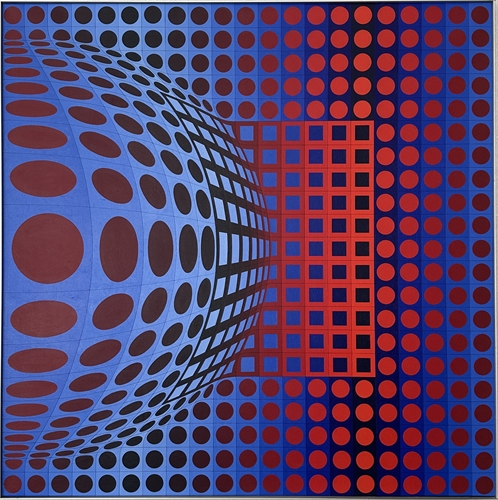
Fel-Zett
1968-1974
Acrylic on canvas
100 x 100 cm
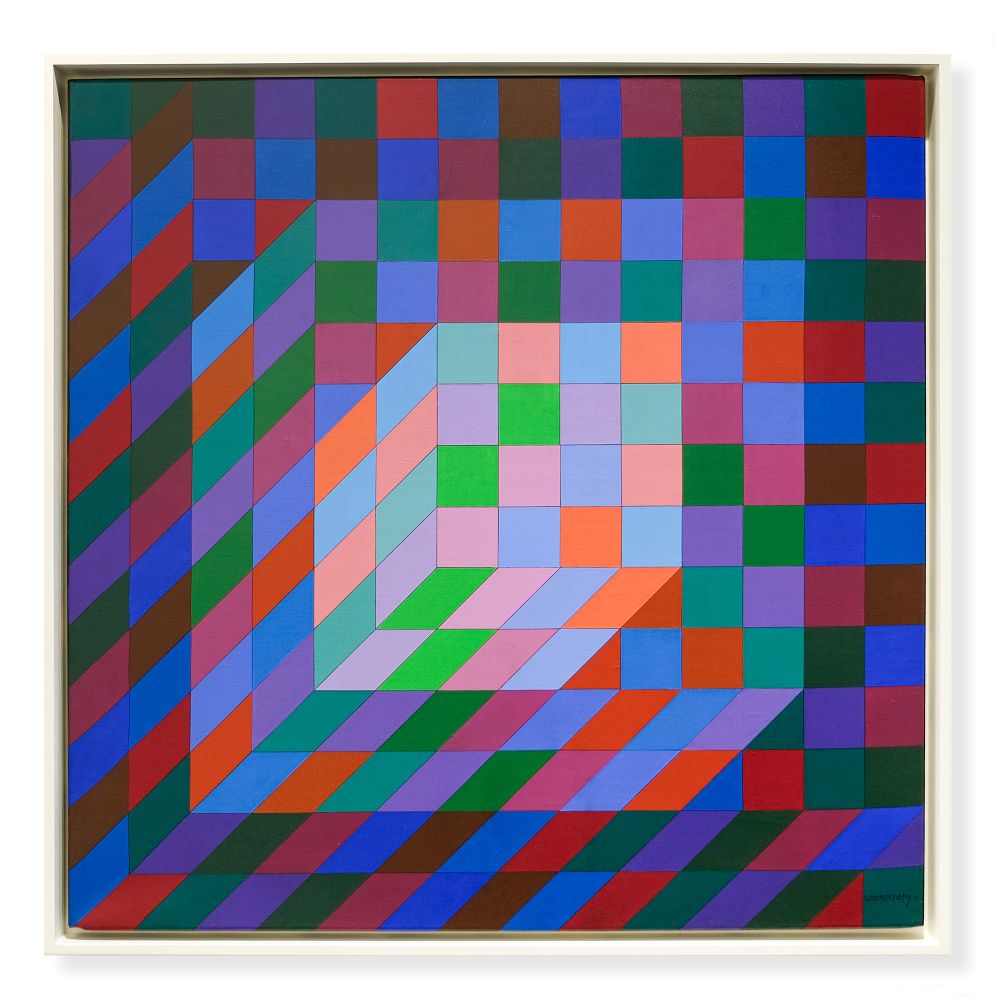
Sobor
1976
Acrylic on canvas
84 x 84 cm
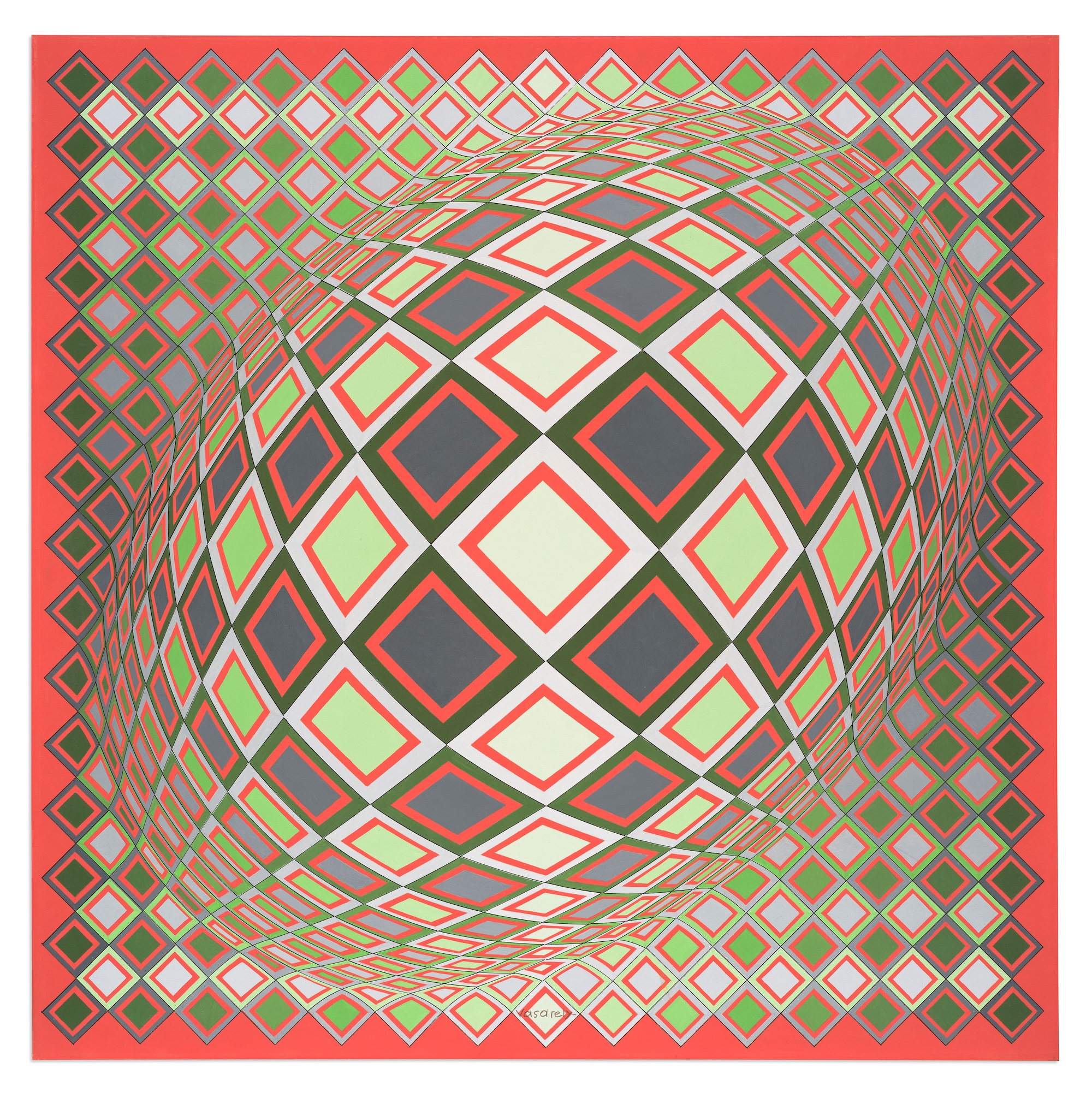
Teke-Pré
1978
Acrylic on cardboard
50 × 50 cm
Victor Vasarely is widely regarded as the founder of Op Art, a movement that transformed visual perception and continues to influence art, design, architecture and visual media to this day. Born on April 9, 1906, in Pécs, Hungary, Vasarely abandoned his medical studies to pursue a career in art, first at the Podolini-Volkmann Academy and then at Sándor Bortnyik’s Műhely school in Budapest, which specialised in the study of the Bauhaus and modernity.
In 1930 he moved to Paris, where he worked as an advertising graphic designer and began experimenting with optical effects in black-and-white patterns, as in his famous Zebras. From 1944 he devoted himself entirely to painting and exhibited at the Galerie Denise René, which long supported his work. In 1947, during a stay on Belle-Île in Brittany, he perceived what he called the “internal geometry of nature”: from then on, geometric forms became the sole basis of his art.
In 1955 he published the Yellow Manifesto (Manifeste jaune) for the exhibition Le Mouvement at the Galerie Denise René, one of the founding texts of kinetic art, and took part in the first three editions of documenta in Kassel (1955, 1959 and 1964). In the 1960s he developed what he called a “plastic alphabet”: a system of shapes and colours that could be combined in infinite ways to create optical illusions and dynamic tensions. In works such as Sirius II and the Planetary Folklore series, his interconnected geometric compositions produced visual vibrations that engaged the viewer directly. In those years Op Art was in dialogue with Italian kinetic and programmed art, of which Bruno Munari was a leading figure. In 1965 the exhibition The Responsive Eye at the Museum of Modern Art in New York established Op Art internationally.
Vasarely’s work was not confined to painting: his theories integrated art, architecture and the environment, in the belief that art should reach everyone. “Art for all” was his motto. In the late 1960s he began the Vega series, in which geometric grids seem to swell towards the viewer, and in the 1970s he redesigned the Renault logo. In 1966 he and his wife Claire created the Vasarely Foundation, whose building in Aix-en-Provence, designed by the artist as a centre for artistic research and experimentation, opened in 1976. He had already opened the Didactic Museum at the Château de Gordes in 1970, followed by museums dedicated to him in Pécs and Budapest.
Following decades of international exhibitions and design projects, he died in Paris on March 15, 1997, leaving behind a visual legacy that redefined the boundaries between form and perception. In 2019 the Centre Pompidou in Paris dedicated a major retrospective to him, Sharing Forms.
In 2017 Repetto Gallery presented a solo exhibition of Vasarely’s work in collaboration with the Vasarely Foundation. The works currently available at the gallery, are original paintings from the full maturity of his geometric language. For information on available works by Victor Vasarely, contact the gallery.